Run your analytics on clinical dataget insights in days not months

Validate your hypotheses, narrow your target or biomarker panels, de-risk your trials — by running on real external patient cohorts from hospitals and biobanks.

No data transfer required. Ethically compliant. Full protection for data and models.

The problem

The clinical data you need exists. You just cant reach it.

Hospitals sit on deeply characterized patient cohorts — multi-omics, longitudinal follow-up, genetically confirmed diagnoses. But governance, privacy regulation, and IT complexity mean pharma cannot access the data directly. Data licensing negotiations take months. Building your own cohort takes years.

Biomarker panels validated in one population fail to translate to another. Without running your own analytics on an independent cohort, you're designing trials on assumptions.

In rare disease, finding patients is already hard. Setting an inclusion criterion wrong — a lab value cutoff that excludes 40% of eligible patients — blocks recruitment entirely. Without real-world distributions from an independent cohort, trial design is guesswork.

tracebloc removes the bottleneck. Your analytics travel to the data. Patient data stays at the hospital. You get results in weeks, not quarters.

How It Works

Your algorithms travel to the data.

Patient data never leaves the hospital. You send your candidates and model specifications — we return aggregate results only.

01
You Submit
Candidate biomarker list (HUGO, UniProt, HMDB)
Model specification & parameters
Outcome definition, disease filters, age range
02
We Run
Models train inside the hospital's secure environment
Cross-validation across the clinical cohort
Multi-omics integration when applicable
03
You Receive
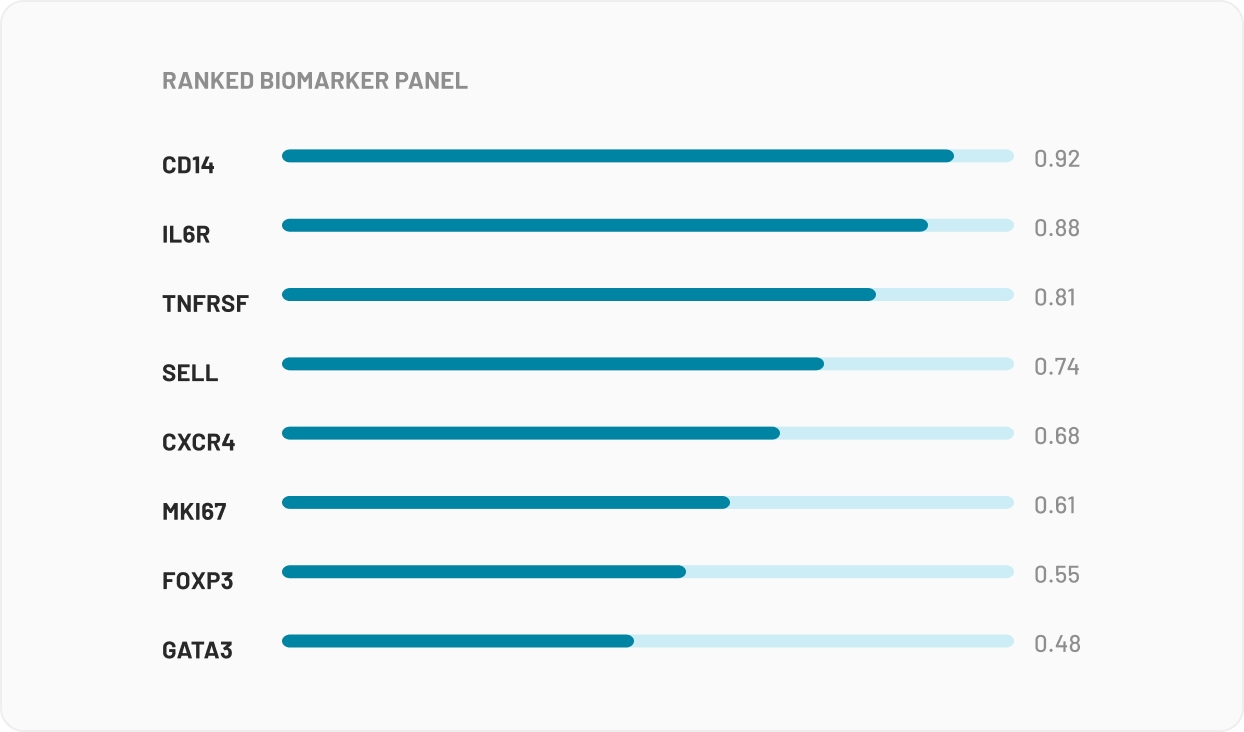
Ranked biomarker panel by selection frequency
Performance metrics (AUC, confidence intervals)
Age-, sex-, and disease-stratified breakdowns
Who This Is For
Built for the teams that need clinical data most.
Clinical Genomics & Biomarker Teams
The challenge
You have candidate biomarker lists from adult studies and need to narrow them on an independent clinical cohort before committing to a trial. Recruiting your own cohort with longitudinal omics takes 18–24 months and costs $500K–$2M.
How we help
Submit your candidates. Get ranked, validated panels back in weeks. Longitudinal datasets answer whether markers predict treatment response in the populations you're targeting.
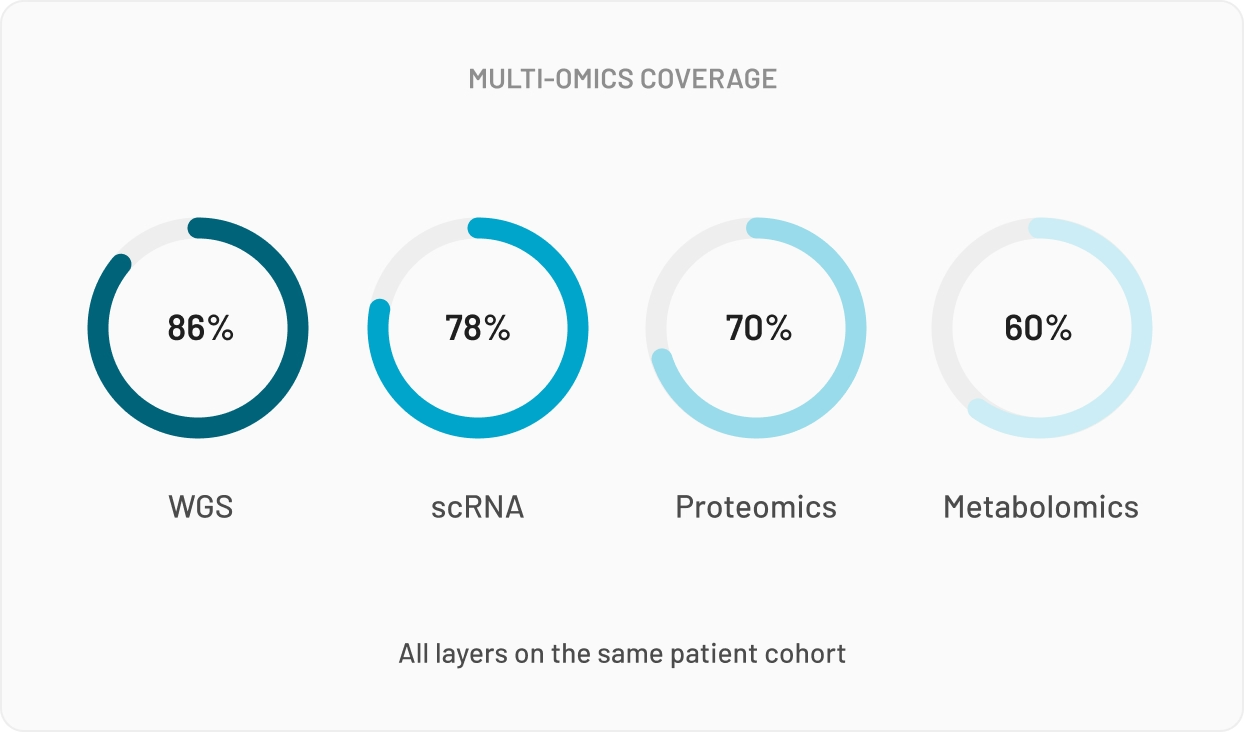
Multi-omics Coverage
Pre-Clinical & Translational R&D
The challenge
Your data science team is building knowledge graphs and AI models but lacks access to deeply characterized multi-omics cohorts. Most available data is shallow, siloed, or limited to a single modality.
How we help
Run analytics across genomics, transcriptomics, proteomics, and metabolomics — on cohorts with standardized HPO, SNOMED-CT, and LOINC mappings. Structured for computational use.
Rare Disease Biotechs
The challenge
You're developing therapies for rare indications but lack the patient scale to power biomarker discovery internally. Every patient matters when the disease affects hundreds, not thousands.
How we help
Access cohorts with genetically confirmed diagnoses — high-value for target validation and panel narrowing without building a consortium from scratch.
Multi-omics Coverage

The Platform

See the use case in action.

Select a cohort, configure your analysis, and review ranked results — all without patient data ever leaving the hospital environment.

Use cases

Five workflows. Real pharma problems.

Each scenario maps to how pharma actually acquires and validates clinical data — shaped by conversations with clinical genomics leads, bioinformatics heads, and commercial teams.

Treatment Response Panel Narrowing

Your team has 800 candidate biomarkers from adult Phase II. Before investing in a pediatric trial, you need to identify which markers reliably predict treatment response in an independent clinical cohort. The longitudinal design – baseline versus post-therapy – answers the exact question.

From 800 candidates → 22 high-confidence biomarkers → 15-gene NanoString panel

What you receive

  • Ranked biomarker list by selection frequency across 1,000 models
  • Direction of effect (up/down in responders vs. non-responders)
  • Age-stratified performance breakdowns
  • Algorithm consensus across LASSO and Random Forest

Cell-Type Specific Biomarker Discovery via scRNA

Single-cell RNA data on genetically confirmed patients is commercially non-existent for most rare indications. Identify which genes in which immune cell populations carry predictive signal – across indications. Cross-indication design enables shared pathway signature discovery

scRNA with cell-type annotation + genetically confirmed patients + longitudinal design

What you receive

  • Cell-type ranked biomarker list
  • Cross-indication overlap (shared vs. disease-specific)
  • Flare vs. remission delta per biomarker
  • Cell population enrichment analysis

Multi-Omics Panel Narrowing

Submit candidates across three omics layers simultaneously. The platform identifies where cross-omic signal — a gene's expression plus its protein level plus downstream metabolite — outperforms any single-layer model alone. Genetic ground truth removes diagnostic uncertainty from training.

Multi-omics panels are more robust to measurement noise in clinical settings

What you receive

  • Per-layer rankings (transcriptomics, proteomics, metabolomics)
  • Cross-layer consensus biomarkers
  • Minimal panel achieving target AUC
  • Safety endpoint signature analysis

Metabolic & Rare Disease Stratification

For ultra-rare indications, even small genetically confirmed cohorts are enormously valuable. Validate which metabolic pathway biomarkers predict treatment response in populations where no other commercial validation pathway exists.

Ultra-rare cohorts with genetic confirmation — unavailable from any other commercial source

What you receive

  • Metabolite rankings with pathway annotations (TCA, fatty acid, amino acid)
  • Cross-omics validation (metabolite ↔ transcriptomic correlation)
  • Longitudinal trajectory (baseline vs. post-therapy)
  • Subgroup analysis: shared vs. disease-specific signals

Healthy Reference Atlas

Reference ranges for most omics biomarkers do not exist in many clinical populations. Without them, you cannot distinguish drug effect from natural biological variation. This use case requires no disease matching — it's relevant to any company running a trial in the target population.

Disease-agnostic — relevant to any pharma company running a clinical trial in the target population

What you receive

  • Age-stratified reference ranges per biomarker
  • Developmental trajectory modeling
  • Sex-stratified data where relevant
  • Regulatory documentation suitable for PIP/BPCA submissions

The data

Deeply characterized clinical cohorts — structured for pharma R&D.

check

Multi-Omics Coverage

Whole genome sequencing, bulk + single-cell RNA-seq, proteomics, and metabolomics – all on the same patients.

check

Deep Phenotyping

Structured ontology mappings (HPO, SNOMED-CT, LOINC) across medical histories, doctor's letters, and clinical lab routines.

check

Longitudinal Design

Multiple visits per patient capturing disease progression and treatment response directly — not a single snapshot.

check

Healthy Controls

Full multi-omics coverage on age-matched healthy controls for clean baseline comparisons across all analyses.

check

Genetically Confirmed Diagnoses

Genetic ground truth across multiple rare disease groups removes diagnostic ambiguity from model training.

check

Privacy by Architecture

Data stays at the hospital. Algorithms travel to the data. You receive aggregate statistics, ranked panels, and performance metrics only.

Why Trust This

Clinical-grade data. Academic rigor. Industry-validated workflows.

Hospital-Originating Data

All datasets originate from registered clinical studies at leading European university hospitals — with formal ethics approval, structured consent, and research-grade phenotyping. Not scraped, not aggregated — clinically collected under protocol.

Scalable Hospital Network

Connected to a growing network of leading university hospitals across Europe — providing the infrastructure for scaling cohorts across populations, therapeutic areas, and geographies.

Clinical data and privacy architecture

Industry-Shaped Use Cases

Every workflow on this platform was validated through conversations with clinical genomics leads, bioinformatics heads, and commercial teams at major pharma and biotech companies. These are real workflows, not theoretical scenarios.

Privacy Architecture

No data leaves the hospital. No individual patient predictions are returned. The entire compute pipeline runs inside the hospital's secure environment — your team receives aggregate statistics only.

Tell us your indication. We'll tell you what's in the cohort

A 30-minute call to discuss your therapeutic area, active programs, and whether our datasets fit your pipeline. No commitment, no generic pitch — just the disease groups, patient counts, and omics layers relevant to you.

Or email directly: info@tracebloc.io

Schedule a meeting

See how tracebloc helps you evaluate, build, and select AI that performs best on your data.