

AI Vendor Evaluation: You Decided to Buy AI. Now What?
Most AI vendor evaluations fail. Discover how to benchmark vendors on your data, measure real performance, and avoid costly mistakes.

Lukas Wuttke
Mar 10, 2026
15 min
You've had the build-or-buy conversation. You decided to buy. Maybe your data science team is stretched. Maybe the use case is too critical to spend eighteen months building from scratch. Maybe you looked at what's available in the market and concluded that a specialised vendor should outperform what you can build internally.
Good. That's the right call for a lot of organisations. But it's also where the real problem starts — because the way most enterprises evaluate AI vendors is fundamentally broken, and almost nobody talks about why.
The one thing you need to get right
Here's the core of it: the only number that matters when choosing an AI vendor is how their model performs on your data.
Not on their demo data. Not on the benchmark in their proposal. Not on a case study from a different company in a vaguely similar industry. On your data, against your existing baseline, measured on your success metrics.
This sounds obvious. Almost no one does it.
Why? Because it's structurally very difficult. And that structural difficulty is what makes the entire vendor evaluation process unreliable. But before we get into the why, it's worth understanding what's at stake when model performance isn't measured properly — because the consequences are not what most people expect.
What getting model performance wrong actually costs
A global payments provider in Frankfurt — 5 billion transactions per year — needed to improve its fraud detection. The internal system combined rules with LightGBM models and worked adequately on normal patterns, but it was failing on edge cases: low-value micro-frauds, synthetic identities, cross-border patterns. The Head of Fraud Analytics evaluated three external AI vendors.
The requirements were non-negotiable: sub-40ms latency per transaction, ≥99.5% recall on known fraud patterns, false positive rate at or below 1%, on-premises deployment, and explainable outputs for regulatory traceability. In fraud detection, these constraints aren't aspirational — they're production hard limits. A model that misses any one of them can't be deployed, regardless of how impressive its accuracy looks.
Here's what the vendors claimed:
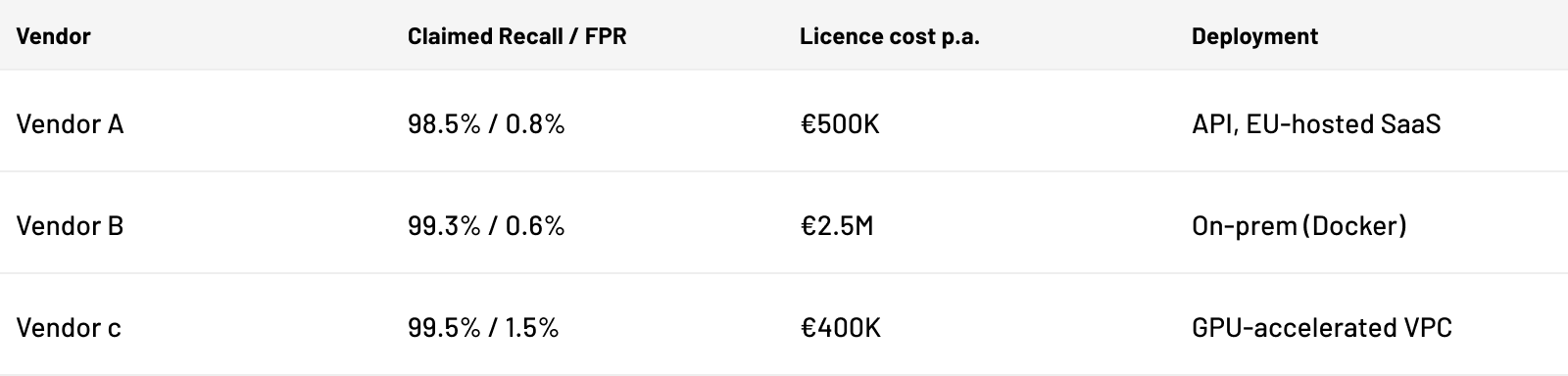
On paper, Vendor C looks attractive — highest recall, lowest cost. Vendor B looks overpriced. Based on proposals alone, most procurement teams would shortlist C and question whether B is worth 6x the price.
All three vendors were evaluated in parallel inside a secure environment on the company's own infrastructure. Vendors fine-tuned their models on synthesised transaction data without ever accessing raw records. Here's what actually happened:
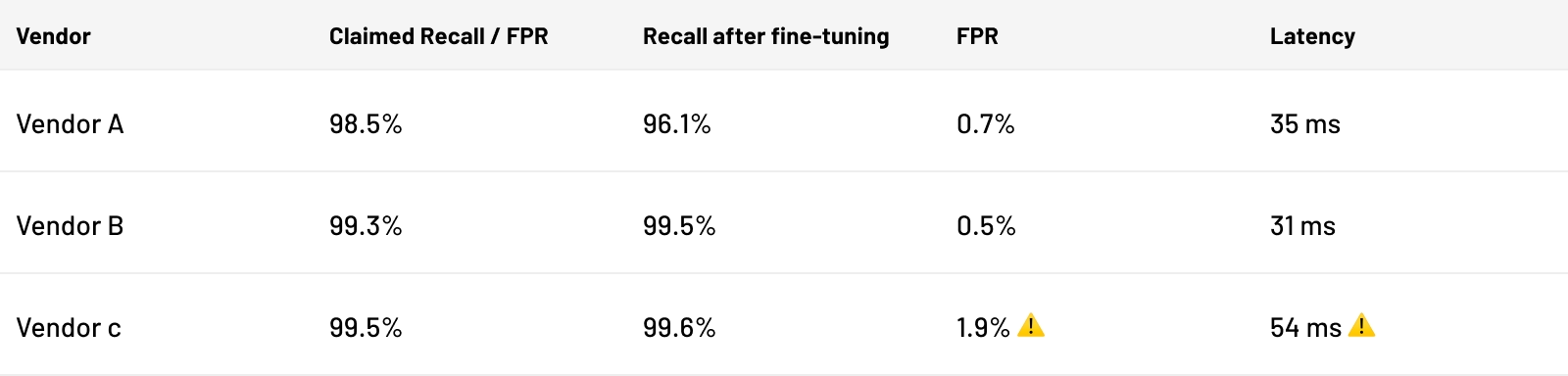
Vendor C achieved the highest recall. It also failed on two hard constraints. Its 1.9% false positive rate — nearly double the 1% limit — would generate 95 million unnecessary friction events annually across 5 billion transactions. Its 54ms latency breached the real-time scoring requirement. High accuracy, unusable model.
But the real lesson is in the business case. When you model the total cost — missed fraud at €120 per incident, false positives at €0.20 per event — the picture inverts completely:
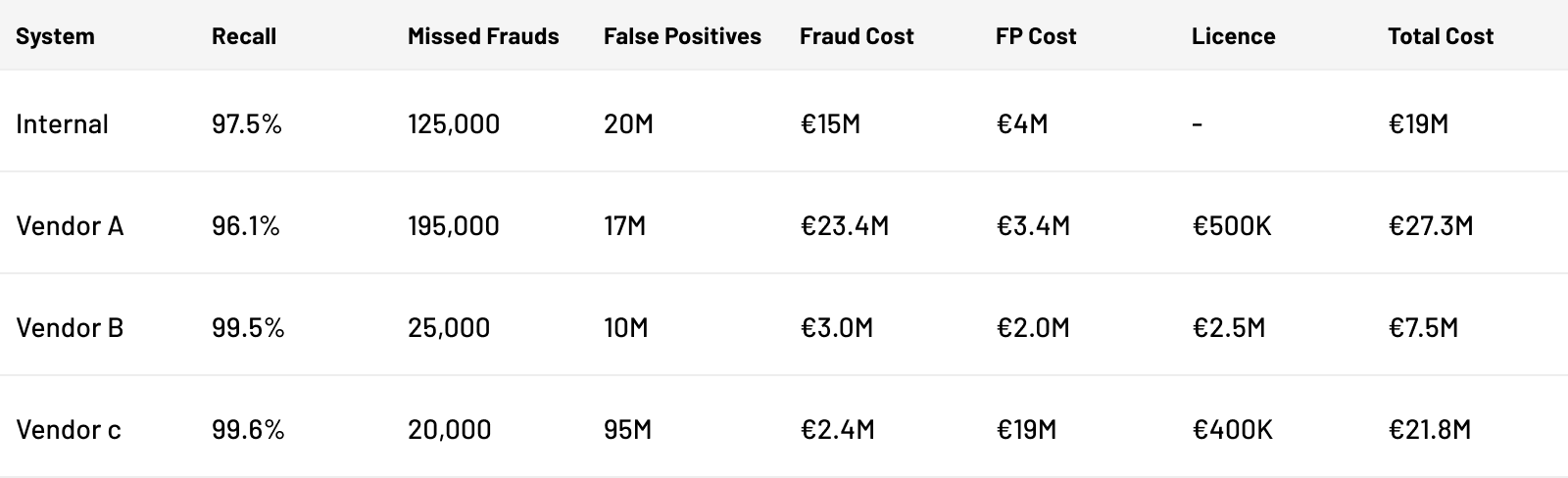
Vendor A — the mid-priced option — is actually worse than doing nothing. Its lower recall means more missed fraud, and the total cost exceeds the internal system by €8.3M. Vendor C's €400K licence generates €19M in false positive costs alone — nearly 50x its price tag. And Vendor B — the one that looked overpriced at €2.5M — reduces total cost from €19M to €7.5M, saving €11.5M per year.
This is what model performance means in practice. Not a number in a vendor proposal. A direct line to your bottom line — where small differences in the right metrics compound into millions, and where the relationship between licence cost and total cost is routinely inverted. If you don't get model evaluation right, nothing else in the vendor selection process matters. And the more precisely you can measure it, the more value you capture.
Why this is so hard
AI models are not software in the way most enterprise buyers are used to thinking about software. You can't evaluate an AI model by reading documentation, checking a feature list, or running a demo. A model's value is entirely a function of how it performs on data it hasn't seen before — specifically, your data.
And this is the problem: you can't share your data.
If you're a bank, your customer financial data is regulated under GDPR, GLBA, and sector-specific rules. If you're a hospital, HIPAA governs every patient record. If you're a retailer, your transactional and behavioural data is a competitive asset you'd never hand to an external party. Even in manufacturing or logistics, operational data is proprietary intelligence.
53% of senior IT leaders in a recent survey cited data privacy as their single biggest barrier to AI adoption — above cost, above integration complexity. And this isn't irrational caution. GDPR penalties run up to 4% of global annual revenue. The risk is real.
So you're stuck. You need to test the model on your data to know if it works. You can't give your data to the vendor. And this tension — between the need for real evaluation and the impossibility of data sharing — is what breaks the entire process.
What happens instead
Because rigorous evaluation is so difficult, organisations default to proxies. They issue an RFP. They evaluate proposals — methodology documents, credentials, reference cases. They pick a vendor based on who presented best. Then they spend months on legal review, NDA negotiation, security assessment, and compliance onboarding just to get that one vendor to the point where a proof of concept can start.
The POC itself takes another 4–8 weeks and costs €20,000–€150,000. At the end of it, there's no guarantee the vendor's model beats your internal baseline. In practice, this is a common outcome — organisations invest six figures and a year of calendar time only to discover their current system is better.
And they've only tested one vendor.
A European retailer went through exactly this process for dynamic pricing. Over a year. Roughly €1 million invested. The consultancy they selected — a major name, chosen on the strength of their proposal — delivered a model that didn't outperform the retailer's existing system. They'll never know whether a different vendor might have solved the problem, because the process only had room for one bet.
This is the default. Not the exception.
What good evaluation actually requires
Strip away the process failures, and what an enterprise actually needs is straightforward:
-
Test on your data.
There is no substitute. Vendor benchmarks are a starting point for conversation, not a basis for a decision. The model must run on your historical data, and its performance must be measured against your existing system. -
Evaluate multiple vendors at the same time.
Sequential POCs are the single biggest structural failure of current procurement. They're slow, expensive, and they don't produce comparisons — they produce isolated data points. You need vendors benchmarked head-to-head, on the same dataset, with the same criteria, in the same evaluation window. -
Define your criteria before you engage anyone.
What are you measuring? What are the hard constraints? What does the model need to do in production — not just in accuracy, but in latency, explainability, and integration? Fix these before the first vendor is contacted. Otherwise every evaluation becomes a negotiation about what success means after the fact. -
Measure total cost, not licence cost.
The fraud detection case above shows this starkly — the cheapest licence was the most expensive decision by an order of magnitude. Evaluation must account for integration costs, ongoing support, retraining frequency, and most critically, the downstream business cost of model errors. A vendor that looks expensive on the line item may be the cheapest option when you model what their model performance actually saves or costs you. -
Require fine-tuning in your environment.
A vendor's off-the-shelf model is not the model that goes into production. What matters is how the model performs after it's been fine-tuned on your data. If a vendor can't fine-tune inside your infrastructure, you're evaluating a generic product, not a solution tailored to your problem. -
Test explainability before you sign.
In regulated industries — and increasingly in any enterprise context — a model that can't explain its decisions is a model you can't deploy. Don't take "we support SHAP" as an answer. Test it during evaluation. Make it a pass/fail gate.
The architectural solution
Everything above depends on solving the core paradox: you need to test on your data, but you can't share your data.
The answer is to flip the model. Instead of sending your data to the vendor, the vendor sends their model to you. The model is evaluated inside your infrastructure, on your data, and only the performance metrics leave your environment. Your data never moves.
This isn't theoretical. It's a practical application of privacy-preserving AI — and it's the architectural principle that makes real vendor evaluation possible in regulated enterprises.
tracebloc is built on this principle. It deploys inside your infrastructure — Azure, AWS, on-premises — and creates a controlled environment where multiple vendors submit their models in parallel. Each model is trained and benchmarked on the same held-out data, against the same criteria, and against your internal baseline. The result is an empirical ranking of which vendor actually performs best for your use case. Not a recommendation based on who presented well. A scoreboard based on who performed best.
The question to ask any platform — including this one — is simple: does it run on my data, inside my infrastructure, without my data leaving my environment? If the answer is no, the data privacy problem hasn't been solved. It's been deferred.
The shift
AI vendor evaluation has been treated as a procurement problem — something you manage through RFPs, legal review, and reference calls. It's not. It's a measurement problem. And until you can actually measure model performance on your data, in your environment, across multiple vendors at once, you're making a bet — not a decision.
The organisations that turn evaluation into a repeatable, evidence-based capability will compound that advantage over time. They'll deploy better models, replace underperforming vendors faster, and build genuine confidence in their AI investments.
Everyone else will keep choosing based on slide decks.
Frequently asked questions about AI vendor evaluation
Answers to common questions